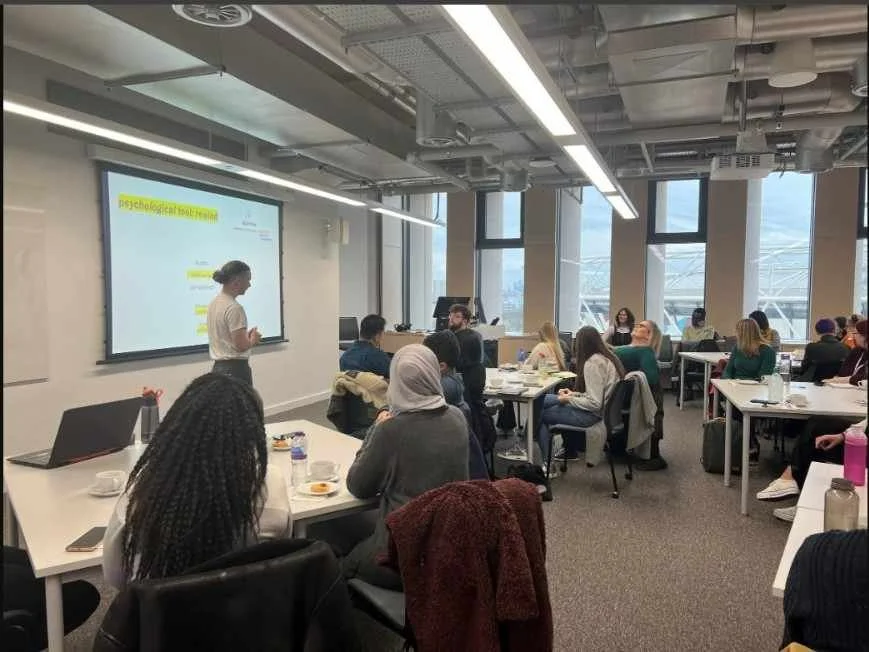
Almost everyone who has run a leadership programme has felt the same quiet disappointment. The two days went well. The feedback was glowing. People left energised, with a workbook full of models and a fresh set of intentions. And within a month, the corridor looks exactly as it did before. The manager who swore to delegate is still hoarding decisions. The programme did not fail in the room. It failed in the gap between the room and the job.
Most leadership training fades because of the transfer gap: skills practised in a classroom do not survive contact with the pressured, real job. Research is blunt about the stakes, with McKinsey finding around 70% of large change programmes miss their goals. Training sticks only when it is built for Kirkpatrick Level 3, behaviour on the job, and embedded through rehearsal, follow-up and measurement, not delivered as a one-off event.
Why this matters now
The transfer gap is the distance between what a leader can do in a workshop and what they actually do back at their desk under real pressure. It is where most leadership budgets quietly evaporate. The stakes are not small: McKinsey's transformation research has long found that around 70% of large change programmes fail to meet their stated goals, and a big part of that is people who were trained but never changed. A programme that does not cross the transfer gap is not a development cost. It is a development write-off with good catering. Our piece on the signs a leadership programme has failed covers how to spot it early.
Why the gap exists
The gap opens for a structural reason. Most leadership training is designed for the classroom, where the conditions are calm, the stakes are imaginary and there is time to think. The job is none of those things. It is interruptions, politics, tired people and decisions made in the ninety seconds before a meeting. A behaviour rehearsed in comfort does not automatically fire under load, because the two situations trigger completely different states. This is exactly why a single day rarely holds, a point our guide on whether one-day training actually lasts examines in detail.
What the frameworks tell us
Kirkpatrick's model, reaffirmed by Kirkpatrick and Kirkpatrick in 2016, is explicit that the level that matters is Level 3, behaviour: are people doing the job differently weeks later. Level 1 reaction and Level 2 knowledge are easy to hit and prove almost nothing about transfer. Our explainer on the Kirkpatrick model walks through why the jump from Level 2 to Level 3 is the whole game. The reason that jump is hard is not mysterious. Skills fade without use, and knowing a delegation model is not the same as delegating when you are stressed and the deadline is real. This is the same mechanism that makes so much L&D spend fail to become behaviour: information is delivered, behaviour is assumed, and nobody checks.
What closes the gap
Because real behaviour change happens through lived experience that makes the memory stick, the fix is to build the training to look like the job, not the classroom. That means three things a slide deck cannot provide: rehearsal under realistic pressure, so the new behaviour is practised in the state it will actually be used in; follow-up after the event, so a single day becomes a sequence rather than a spike; and measurement at the behaviour level, so transfer is observed instead of assumed. In a Sidestream programme, trained actors put leaders in the pressured version of the real moment, and the same task is run before and after so the change is visible. Our training and development work is built around embedding rather than events, and our piece on how behaviour change improves leadership sets out the underlying method.
A workshop is not a result. It is a promise that only pays out if the behaviour survives the walk back to the desk.
The practical move for anyone commissioning leadership development is to stop buying events and start buying transfer. Ask the awkward question before you sign: how will we know, in observed behaviour a month from now, that anything changed. If the answer is a feedback form, you are funding the gap, not closing it. The programmes that stick are the ones designed from the first day for the walk back to the desk.
The Transfer Gap: The Takeaways
Most leadership training fades because of the transfer gap, the distance between what a leader can do in a calm classroom and what they do under real pressure. McKinsey finds around 70% of large change programmes miss their goals, and untransferred training is a big part of it. Kirkpatrick's model puts the value at Level 3, behaviour, and the gap closes only through rehearsal under pressure, follow-up and behaviour-level measurement.
- The transfer gap is the distance between classroom capability and on-the-job behaviour under pressure.
- McKinsey's research finds around 70% of large change programmes fail to meet their stated goals.
- Most programmes evaluate only at reaction level, so transfer failure goes undetected (CIPD Learning at Work).
- The gap closes through rehearsal in realistic conditions, follow-up over time and measurement at Kirkpatrick Level 3.