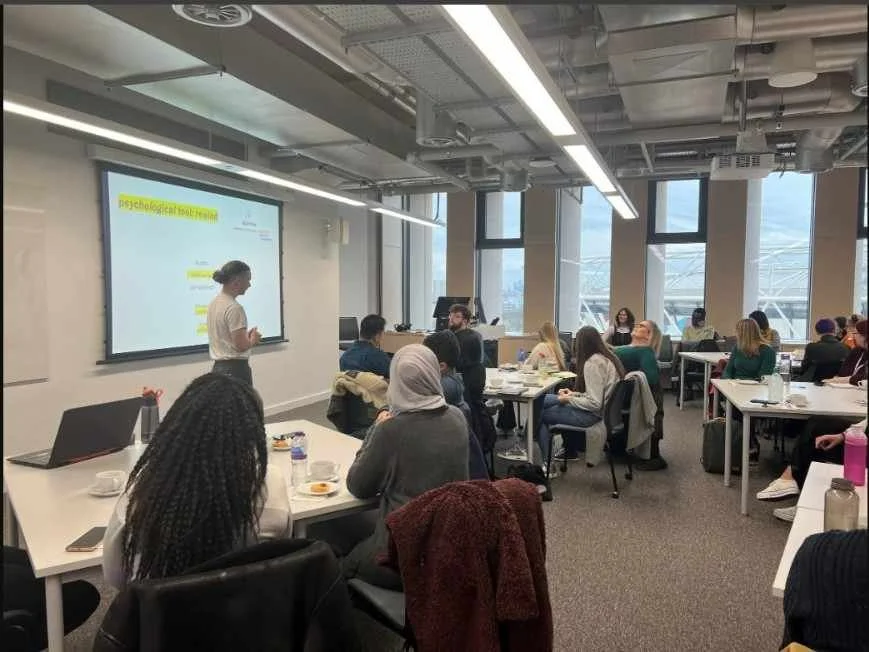
This is an illustrative account of a typical participant experience, not a specific individual.
Immersive simulation training is a live learning method where you practise a realistic, scripted workplace scenario with professional actors rather than reading about it. You step into a credible situation, make decisions under genuine pressure, and the actors respond in character. You rehearse it in waves, get honest feedback between attempts, then debrief what changed. Sidestream builds these around organisational psychology so the behaviour, not the slide deck, is what sticks.
I went into the room expecting something like a workshop. A circle of chairs, a flip chart, somebody asking how the quarter had gone. What I got instead was a working version of my own job, handed back to me with the difficulty turned up. I want to describe what that was actually like, because before I took part in immersive simulation training I had no real idea what the words meant, and I suspect most people booking it for their teams do not either.
The Setup
The facilitator explained the frame in about three minutes. There was a scenario, written in advance and grounded in the kind of situation my role throws up regularly, and professional actors who would play the other people in it. My task was not to perform or to get a right answer, but to handle the situation the way I would at work, and then to do it again, better, with what I learned in between. The scripting was real but the responses were live: the actors knew their characters cold, and they would react to whatever I actually did.
What surprised me first was how quickly the pretend fell away. I had assumed the artificial setup would keep me at arm's length. It did not. Within a minute of the actor sitting down opposite me, defensive and slightly cold, my heart rate was up and I had forgotten the people watching. This is not role-play as I had lazily imagined it, two colleagues reading lines without conviction. The other person in front of me was completely convincing, and my body responded to them as if the stakes were genuine.
The First Wave
The first attempt did not go well, and I knew it while it was happening. I had led versions of this conversation many times, and on paper I knew exactly what to say. In the room, with someone pushing back and going quiet at the wrong moments, I rushed. I filled silences I should have left open. I softened a clear message into something vague because the discomfort was real and I wanted it gone. When the facilitator called time, I sat there slightly winded, aware that the gap between what I know and what I do under pressure is wider than I would ever have admitted in a survey.
The feedback came quickly and it was specific. Not a grade, not a personality label, but a small number of concrete things: where I had retreated, the exact moment I had rushed, what the actor had felt as the character when I did. That last part landed hardest. Hearing the actor describe, in role, what my hurried opening had done to the person across the table told me more than any model on a slide ever has. I had data on my own behaviour, observed rather than self-reported, and it was uncomfortable in the most useful way.
Practising in Waves
Then I went again. This is the feature that separates immersive simulation training from a memorable one-off afternoon. The point was never the first attempt. The point was to take one honest piece of feedback, apply it, and run the scenario again while it was still live in my body. On the second wave I left a silence open on purpose, and watched the actor fill it with something I needed to hear. On the third, I held a clear message without softening it, and the conversation went somewhere the first attempt never could have.
It was not a clean upward line. One adjustment fixed one thing and exposed another. But the loop itself, try, get feedback at the edge of what I could currently do, try again, is exactly how a skill is built rather than merely described. Sidestream's immersive events and simulations are designed around that loop deliberately, drawing on organisational psychology rather than instinct, and you feel the design in how precisely the difficulty is calibrated. The actor pushed harder when I had earned it and eased off when I was struggling, so I was always working at the edge and never simply drowning.
The Debrief
The debrief at the end was not a wrap-up. It was where the loose experience became something I could carry back to my desk. We talked through what had shifted between the first wave and the last, why, and which specific behaviours I would commit to repeating in the real conversations waiting for me. The facilitator connected what I had felt in the room to the principles underneath it, so I left with a method I understood from the inside rather than a handout I would never reopen.
What stayed with me was the honesty of the whole thing. Nobody pretended I had been brilliant in wave one. Nobody flattered the room. The professional actors had held real pressure, the feedback had been direct, and because of that the progress was real too. I had not learned about handling a difficult situation. I had handled one, badly and then better, in a place where getting it wrong cost me nothing except a little pride.
What I Took Away
Weeks later, the part that survived was not a phrase or a framework. It was a felt memory. When a real version of that conversation arrived, my body remembered the silence I had learned to leave and the message I had learned not to soften. That is the claim immersive simulation training makes, and from the inside it holds up: some things cannot be taught, they have to be felt, and once you have felt them under genuine pressure they are far harder to forget.
If you are weighing this for a team, the honest test is simple. Is the thing you need people to get better at something they could fail at in front of a real, unscripted person. If it is, no slide deck will rehearse it. A live scenario with professional actors will. Get in touch today. We are Sidestream.