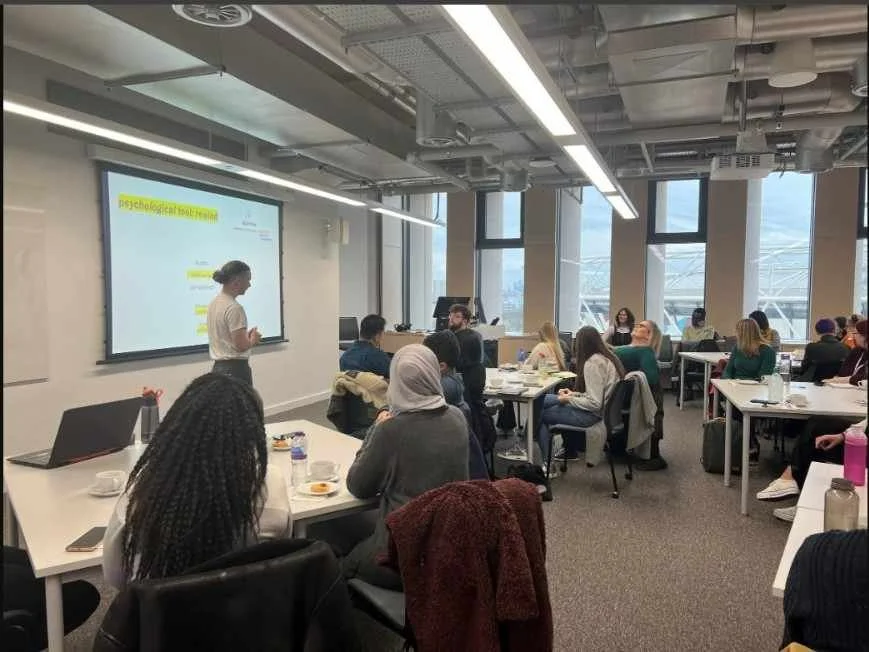
Some things cannot be taught, they have to be rehearsed. You can read every book ever written about handling a grievance, a redundancy or a colleague who has crossed a line, and still fumble the first time a real person is sitting across from you, defensive and upset. Role-play training closes that gap. It is the oldest idea in behaviour change and still the most direct: put a person in the conversation they are avoiding, with someone who will respond as a real human being would, and let them practise until the behaviour holds. This page sets out what role-play training and forum theatre are, why rehearsal with professional actors beats passive learning, and how Sidestream designs and measures the work.
What Role-Play Training Is
Role-play training puts a person into a real interpersonal exchange and asks them to handle it, live. The defining features are three. The other person is played well enough that the participant responds as they would at work. The participant does the behaviour, speaks the words, holds the silence, rather than discussing the conversation in the abstract. And there is a debrief, then another attempt, so the capability is built through iteration rather than delivered in a single pass.
That last feature is what separates role-play training from a one-off demonstration. Watching a skilled facilitator model a difficult conversation is useful, but watching is not doing. Capability is built by repetition with feedback at the edge of current ability, the condition Anders Ericsson identified as deliberate practice in Peak (2016). A role-play that runs once and is never revisited is a memorable afternoon. A role-play that runs, is debriefed honestly, and runs again is how interpersonal behaviour actually shifts.
Role-play training is sometimes called drama-based training, because the technique borrows from the rehearsal room rather than the lecture hall. The label matters less than the discipline behind it: a real exchange, a credible other person, an honest debrief, and another go.
Forum Theatre: Role-Play for the Whole Room
Forum theatre is the group-scale form of the same idea. Developed by the Brazilian theatre practitioner Augusto Boal, it works like this. Professional actors perform a short scene that goes wrong: a manager handles a disclosure badly, a team talks over its only dissenting voice, a leader lets a remark slide that should have been challenged. The scene is recognisable, uncomfortable and true to the cohort's world. Then it replays, and this time the audience can stop the action, step in, and direct a different choice. What if she had said this instead. What if he had not let that go. The actors take the redirection and play it out, and the room sees the consequence.
Forum theatre does something individual role-play cannot. It makes the unspoken norms of a workplace visible to everyone at once: what gets challenged and what gets tolerated, who speaks and who stays quiet, where the conduct line actually sits as opposed to where the policy says it sits. Because the cohort directs the alternatives, the better behaviour is theirs, not the trainer's. Sidestream uses forum theatre where the behavioural target is collective, around conduct, inclusion and speak-up culture, and individual actor-led role-play where the target is one person's capability in a specific exchange. Most of our drama-based work blends the two.
Why Rehearsal With Professional Actors Beats Passive Learning
The evidence on passive learning is not subtle. Keynotes talking at people, slide decks, video modules, end-of-course questionnaires: they transfer information and they rarely change behaviour. The reason is structural. Knowing what to say in a difficult conversation and being able to say it while someone is angry in front of you are different capabilities, and only the second one shows up at work.
Donald Kirkpatrick's four-level evaluation framework, updated in Kirkpatrick and Kirkpatrick (2016), makes the distinction measurable. Level 1 is reaction, did people enjoy it. Level 2 is learning, did they acquire the knowledge. Level 3 is behaviour, did they change what they do in real work. Level 4 is results, did that change move an organisational metric. Passive learning is genuinely good at Levels 1 and 2. It struggles at Level 3 because it never rehearses the behaviour. Role-play training is built for Level 3 from the start, because rehearsing the interpersonal behaviour is the entire method. For the measurement model itself, see our guide on what the Kirkpatrick model is.
The professional actor is what makes the difference. Peers playing roles for each other are sympathetic, professionally similar and distracted by their own learning, so the exchange never feels real and the participant performs rather than behaves. A trained actor holds a character, stays in role when the participant gets it wrong, and applies exactly the pressure the rehearsal needs, then dials it back when the participant earns it. That realism is what produces the response the participant will actually have at work, which is the only response worth rehearsing.
An Example Role-Play Session
Consider an example half-day role-play session for a cohort of newly promoted managers at a mid-sized London organisation. The brief, in this illustration, is that capable managers are avoiding the difficult conversation, letting underperformance and the occasional out-of-line comment drift because the conversation feels too hard. The behavioural target is the difficult conversation itself: opening it, holding it, and staying respectful while being clear.
The session opens with a short forum-theatre scene. Two professional actors play a manager and a report, and the manager handles a performance conversation badly: too soft, then suddenly too sharp, then retreating into vague reassurance. The cohort recognises it instantly. The scene replays, and the room stops the action and redirects it, testing what an honest, calm opening would sound like and watching the actor-report respond to each version differently.
Then the cohort moves into individual role-play. Each manager takes a scenario drawn from the kinds of conversation they actually face, while a professional actor plays the report, calibrated to be defensive, upset or evasive as the moment calls for. The manager has to open the conversation, hold the message, and respond to what comes back. The debrief that follows is structured around what the manager did, what the actor felt as the other person, and what a stronger version would look like. Then the scenario runs again, with the adjustment applied.
The measurement, in this illustration, would run at Kirkpatrick Level 3: are these managers observably initiating and handling difficult conversations well in real work three months later, as reported by the people on the other side of those conversations. That is the outcome the work is designed to move, and the only one worth claiming.
Scope a role-play programme
Book a free 30-minute consultation. Bring the conversation you need people to rehearse. We will tell you honestly whether role-play training is the right method.
Book a Free ConsultationHow Role-Play Training Differs From Simulation
Role-play training and simulation training share a family resemblance. Both use professional actors, both run the rehearse-debrief-rehearse cycle, and both measure at Kirkpatrick Level 3. They are not the same method, and choosing the right one matters.
Simulation training centres on a scripted decision or crisis scenario where the behavioural target is a choice made under pressure: weighing competing pressures, committing, holding the line under challenge, coordinating a team while events escalate. The scenario is structured, often with a defined outcome to navigate towards, and the actors play the stakeholders whose input shapes the decision. If the behaviour you need to change is how someone decides and holds a decision, that is the method. Our simulation training page sets it out in full, our immersive simulation training in London page covers the London-specific, venue-led version, and our immersive events work scales the same scripted approach to large audiences and full productions.
Role-play training and forum theatre centre on the interpersonal exchange itself: the conversation, the relationship, the conduct between two people. The target is not a decision but a behaviour towards another human being, the difficult conversation, the speak-up moment, the inclusive response, the leadership exchange that sets a team's norms. The two methods often sit inside the same engagement, but they answer different briefs. Role-play is the right method when the behaviour you need to change is how someone handles a person, not how they handle a problem.
The Behaviour Role-Play Training Rehearses
Across our engagements, actor-led role-play and forum theatre keep returning to a handful of recurring interpersonal targets. The difficult performance conversation, the one capable managers most often avoid. The speak-up moment, where someone has to challenge a senior colleague in real time rather than in the corridor afterwards. The conduct exchange, where a remark or a behaviour crosses a line and the response, or the silence, sets the norm for everyone watching. The leadership conversation that signals what is welcome in a team and what is not. The inclusive response to a moment where inclusion is either reinforced or quietly eroded. Each is interpersonal, each is rehearsable, and each is calibrated to the cohort's real working context rather than a generic script.
The Evidence Behind the Method
Role-play training is not a hunch, it rests on several established research streams. Kolb's experiential learning cycle (1984, 2014) describes the loop of concrete experience, reflection, conceptualisation and experimentation that the rehearse-debrief-rehearse structure operationalises directly. Ericsson's work on deliberate practice (Peak, 2016) establishes that capability is built through structured practice with feedback against a specific target. Roediger and Karpicke's 2006 research in Psychological Science on the testing effect found that active retrieval produces roughly 50% better long-term retention than passive re-reading, and a role-play is active retrieval of behaviour. Amy Edmondson's 1999 work on psychological safety explains why the debrief, and the forum theatre stage, have to be places where people can be honest about what went wrong without fear.
Sidestream's own academic work, building on behaviour-change research from UCL, Cambridge and Bocconi, found immersive role-play approximately 20% more effective than passive modalities at teaching communication skills. The same work surfaced a familiar trap: participants who had only learned passively were confident in a skill their actual performance did not support. Replacing self-report with observed behaviour is how the method avoids rewarding confidence over capability.
How to Start
Book a free 30-minute consultation at calendly.com/info-sidestream. Bring the specific conversation or conduct you need people to rehearse. We will tell you honestly whether role-play training is the right method for your brief, or whether scripted simulation or another approach would serve you better.
Or read more on our services, our workshops and training, and our immersive events. Get in touch today. We are Sidestream.