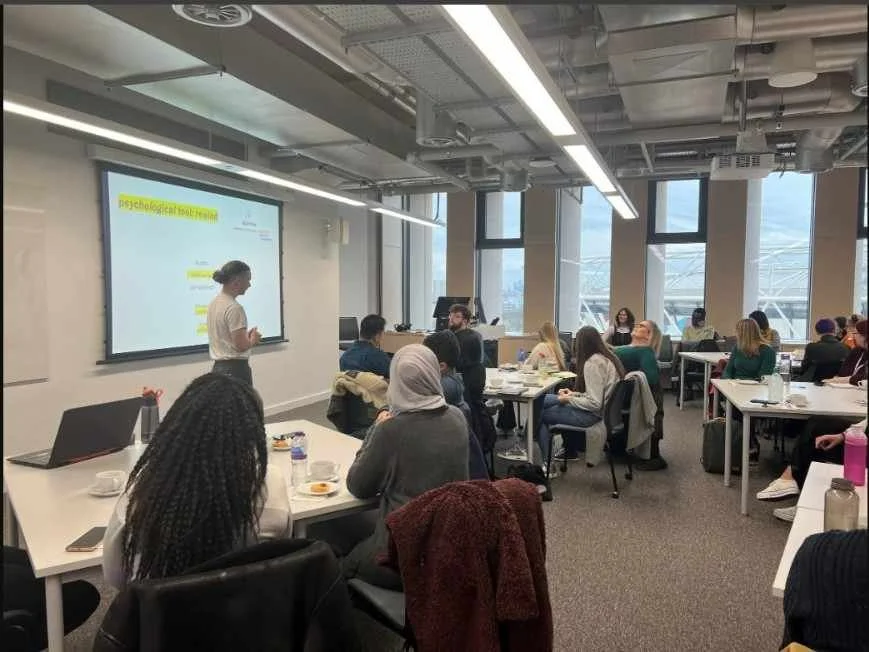
Manager training usually fails to change behaviour because the bottleneck is not knowledge, it is performance under pressure. A manager can pass a quiz on feedback and still freeze in the real conversation. The fix is not more content. It is deliberate practice in realistic, high-pressure scenarios with professional actors, repeated with honest feedback until the new behaviour holds when it counts.
Most manager training works on the wrong problem. It assumes the gap is knowledge, so it pours in more of it: frameworks for feedback, models for delegation, a tidy acronym for handling conflict. Managers sit through it, nod, pass the end-of-course quiz, and rate the day highly. Then they walk back to a tense one-to-one and do exactly what they did before. The content was never the bottleneck. What breaks down is behaviour under pressure, and pressure is the one thing a slide deck cannot manufacture.
Knowing the Answer Is Not the Skill
Ask a manager, in the calm of a classroom, how to give difficult feedback and most will give you a textbook answer. Be specific, describe the behaviour not the person, agree on next steps. They know. Then put a real, slightly hostile person in front of them, with a reputation on the line and a clock running, and the knowledge evaporates. They soften the message until it means nothing. They fill the silence they were told to leave open. They retreat. The information was intact. The performance was not.
Knowing what to do and being able to do it while your heart rate is up are two different capabilities, and only the second one shows up at work. A quiz measures the first. The real conversation demands the second. So the day scores well, the evaluation form glows, and nothing changes on Monday.
Why Pressure Changes Everything
Under threat, the body does predictable things. Cortisol rises, working memory narrows, and the brain reaches for whatever it has done before rather than whatever it learned last week. A difficult conversation registers as a genuine threat, so the manager defaults to their oldest habit precisely when they most need the new one. The framework they revised on Tuesday is still in there somewhere, but it is not what comes out when the room gets hot.
This is why passive learning, the keynote, the e-learning module, the questionnaire, hardly moves the needle on behaviour. It rehearses recall in a state of comfort, then expects the lesson to survive the trip into a state of stress. It almost never does. The training was delivered to a calm brain; the job is done by a pressured one. Real behaviour change training has to work on the pressured brain directly, because that is the only version that turns up to the meeting.
The Transfer Problem Has a Name
None of this is new. The research on transfer of training, Baldwin and Ford's 1988 review of the field, established decades ago that the link between what people learn on a course and what they do back in the job is weak unless the conditions of learning resemble the conditions of use. Practice in a setting that looks nothing like the real one rarely transfers. Practice that mirrors the real demand, including its pressure, is what carries across.
The skill-acquisition evidence points the same way. Anders Ericsson's work on deliberate practice shows that expertise is built by repeated effort at the edge of your current ability, with immediate, specific feedback, then another attempt that absorbs it. Not watching. Not listening. Doing the hard thing, getting told precisely where it broke, and doing it again. That loop is how a surgeon, a pilot or a musician gets good. A manager handling conflict is no exception.
What Rehearsal Under Pressure Looks Like
The practical answer is to stop teaching the conversation and start rehearsing it: a credible scenario drawn from the manager's actual role, a professional actor who plays the other person with full conviction, and a brief that asks the manager not to perform but to handle it the way they really would. Within a minute the pretend falls away. The actor pushes back, goes quiet at the wrong moment, gets defensive, and the manager's body responds as if the stakes were real, because in every way that matters they are.
This is the distinction between genuine role-play training and the half-hearted version most people picture, two colleagues reading lines without conviction. A trained actor holds real pressure. The first attempt usually goes badly, and the manager knows it while it is happening. Then comes feedback that is specific rather than a grade: the exact moment they rushed, what the character felt when they softened the message. Then they go again, applying one concrete change, and run it in waves, each pass calibrated to sit just past what they managed before.
That loop is what simulation training is built to deliver, the difficulty tuned deliberately so the manager works at the edge without drowning. The feedback is behavioural and observed, not self-reported, which matters because people are poor judges of their own performance under pressure. They leave with a felt memory rather than a handout, and weeks later, when the real conversation arrives, the body remembers the silence it learned to leave and the message it learned not to soften.
The Honest Test
Sidestream's own academic work, building on behaviour-change research from UCL, Cambridge and Bocconi, found that immersive role-play was meaningfully more effective than passive modalities such as slide-shows and video e-learning at teaching communication skills. The same study replaced confident self-ratings, which turned out to be inaccurate, with direct behavioural measurement. People thought they were good. The recording showed otherwise. That gap is exactly the one a quiz cannot detect and a live scenario exposes in minutes.
So the test for any manager programme is simple. Is the thing you need people to get better at something they could fail at in front of a real, unscripted person. If it is, no amount of content will rehearse it, and another module will only buy another high evaluation score and another unchanged Monday. A live scenario under genuine pressure, run in waves with honest feedback, is what moves behaviour. Some things cannot be taught, they have to be felt. Get in touch today. We are Sidestream.