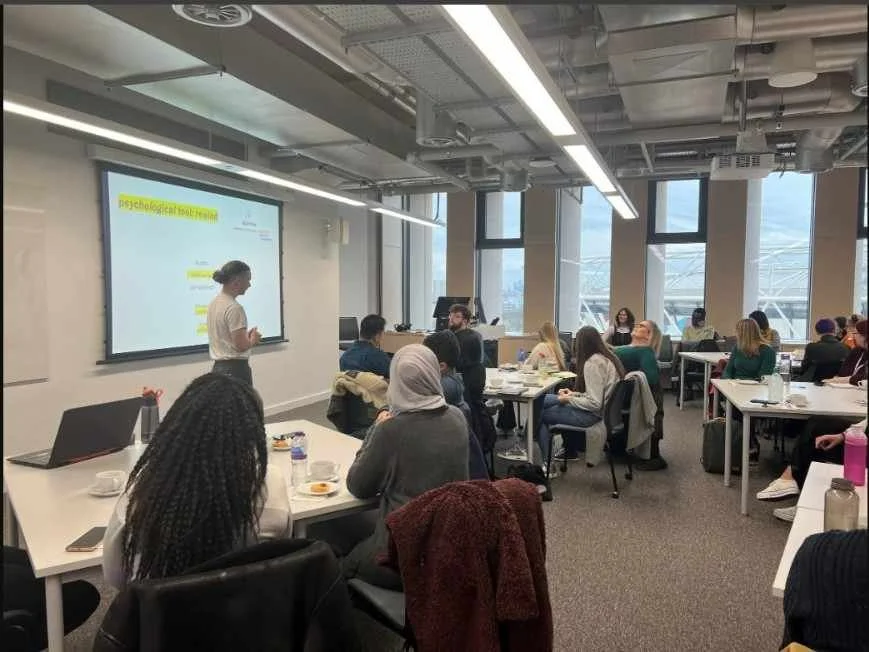
Role-play feels uncomfortable because you are doing the real thing under real pressure instead of hearing about it. That discomfort is not a flaw in the method, it is the method working. Learning that holds is built by attempting the skill, getting it wrong somewhere safe, and trying again with feedback until it changes.
Almost every group includes someone who folds their arms early and says they hate role-play. It is one of the most common objections in corporate learning. The dread is real. People remember a stilted exercise where two colleagues read a script at each other while the room cringed. The discomfort is not the price of the method, it is the mechanism. The squirm is the learning starting to happen.
The thing you avoid is the thing you need to practise
Notice what people dread. It is almost never the easy conversation. The dread shows up around the difficult version: the underperformer who goes quiet, the senior stakeholder who pushes back, the colleague in distress. Those are the moments that decide whether someone is good at their job, and exactly the ones a slide deck cannot prepare you for. You cannot read your way into composure under pressure.
This is the gap between knowing and doing. You can recite the model for a difficult conversation and still fall apart the moment a real person holds eye contact and waits. Good role-play training exists to close that gap, and it can only do so by putting you in the gap first. The discomfort is the distance between what you know and what you can do, made visible, and you close it by being under pressure and coming out the other side.
What the evidence says about doing the thing
The science here is settled. Anders Ericsson, whose work on expert performance is gathered in his book Peak, showed that people improve not by accumulating hours but through deliberate practice: focused repetition at the edge of their current ability, with feedback, on the specific thing they cannot yet do. That edge is, by definition, uncomfortable. If a practice feels smooth throughout, you are rehearsing what you have already mastered.
There is an emotional layer on top of the cognitive one. A scenario where your mouth goes dry and you find the words anyway lays down a memory the way a comfortable slide never can. This is why simulation training is built around realistic pressure, not comfort. Strip the pressure out and you strip out the thing that makes it hold.
The confidence trap, and why self-rating misses it
There is a deeper reason people resist practising the hard thing: they often believe they are already fine at it. In Sidestream's own academic behaviour-change work, building on research from UCL, Cambridge and Bocconi, participants consistently rated their own communication skill well above what trained observers later measured. The confidence was genuine, the skill was not yet there. That is why a method that only asks how people feel will always flatter them. You find the real gap by doing the task and watching.
Making the room safe enough to get it wrong
Here is the part the objection gets right. Plenty of role-play is bad, and bad role-play is not uncomfortable in the useful way, it is just exposing. Being made to perform in front of peers who will rib you afterwards builds avoidance, not skill. The discomfort that teaches is the discomfort of effort, not of humiliation. The job of the design is to separate the two.
Amy Edmondson's research on psychological safety, set out in her 1999 paper in Administrative Science Quarterly, describes a climate where people can take interpersonal risks without fear of being shamed. That is the condition a good practice room needs, so we build for it. When getting it wrong is safe, it becomes the work rather than the failure. The person opposite is a trained actor, not a colleague, so there is no relationship to protect and no audience to perform for. We work in short waves: you have a go, we pause, you name one thing to change, you go back in and try it. The first attempt is data, not a verdict.
This is an illustrative account of a typical participant experience, not a specific individual.
A participant arrives certain they will hate it, and for the first ninety seconds they do. The words come out clumsy and over-rehearsed. The actor, playing a direct report whose performance has quietly slipped, clocks it and goes quiet, and the silence is excruciating. Then we pause. What did you notice. What might you try. They go back in, change one thing, and the conversation moves. By the third wave they are no longer reciting a model, they are having a conversation. The discomfort converted into competence, only because the room was safe enough to be bad in first.
So when someone says they hate it
I take it as a good sign. It usually means they understand that this is real, and that real things carry the risk of getting them wrong. The answer is not to make the practice more comfortable; comfortable practice is how a decade of training produced people who can pass the quiz and still freeze in the meeting. It is to make the room safe enough that being uncomfortable is survivable, then let the discomfort do its job. This is the principle underneath all our immersive simulation training: the safety is engineered so the difficulty can be real.
Some things cannot be taught, they have to be felt. Skill under pressure is one of them. If your people dread role-play, that is not a reason to retreat to the slide deck, it is a sign you are finally pointing the practice at the thing that matters.
Book a free 30-minute diagnostic call → or read about our research-backed approach. Get in touch today. We are Sidestream.
Sources cited: K. Anders Ericsson and Robert Pool, Peak: Secrets from the New Science of Expertise (2016), on deliberate practice; Roediger and Karpicke, “Test-Enhanced Learning”, Psychological Science (2006), on the testing effect; Amy C. Edmondson, “Psychological Safety and Learning Behavior in Work Teams”, Administrative Science Quarterly (1999). Self-assessment finding drawn from Sidestream’s own academic behaviour-change work building on research from UCL, Cambridge and Bocconi.