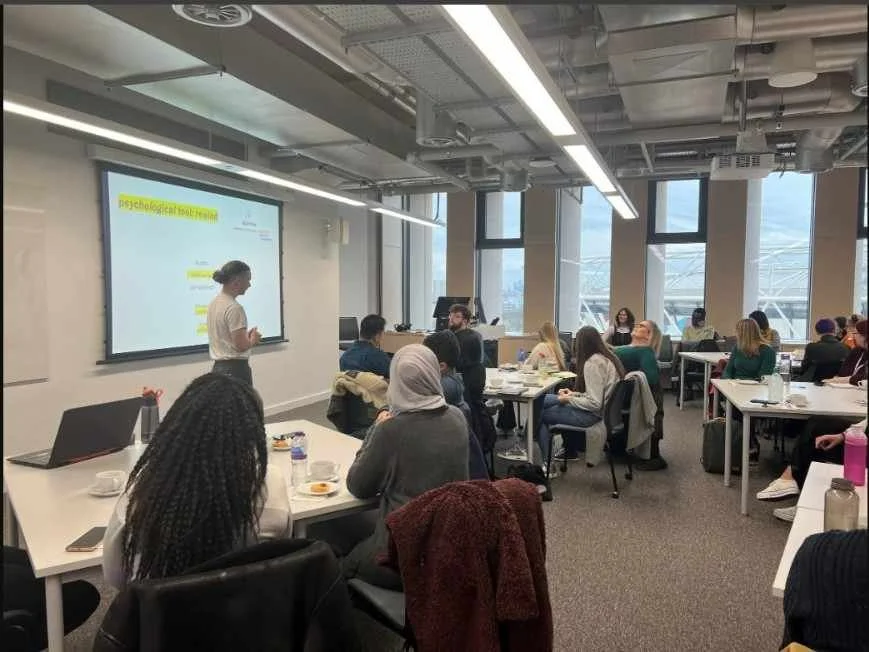
This is an illustrative account of a typical participant experience, not a specific individual.
Immersive simulations are live learning experiences where you step into a realistic, high-stakes scenario and respond as yourself, while professional actors play believable characters who react to your every move. There are no scripts to follow and no slides. You rehearse a difficult behaviour, get honest feedback, and run it again until the new response feels natural under pressure.
I arrived expecting another training day. I had blocked out the morning, half-resigned to a slide deck and a flip chart, the kind of session you nod through and forget by lunch. What I walked into was a room dressed as somewhere real, a meeting space that felt lived-in, and a person already sitting in it who was not a facilitator and not a colleague. They were in character before I had even sat down. Within two minutes I had stopped performing and started reacting, and that was the whole point.
The Moment It Stops Being an Exercise
The brief was simple on paper. I had to have a conversation I had been avoiding at work: telling someone their performance was not where it needed to be. In the room, the actor playing that person did not read from a card. They pushed back. They got defensive, then quiet, then reasonable in a way that made me doubt myself. My heart rate climbed. My mouth went dry. I noticed I was softening the message to keep the peace, exactly the habit I had come to break.
That is the part people do not believe until they feel it. Your body does not know it is a simulation. The pressure is real because the human in front of you is responding live, in the moment, to whatever you actually say. There is no pause button and no right answer printed at the back. I made the conversation worse before I made it better, and I felt every degree of that in the room.
A Safe Space, Which Is Not the Same as a Comfortable One
Here is the paradox at the heart of it. The stakes felt real, yet I was completely safe. Nobody's actual job was on the line. No real relationship would be damaged by my getting it wrong. That combination, real emotional stakes inside total safety, is the thing you almost never get at work, where every clumsy conversation has consequences you have to live with afterwards.
So I was free to fail. And I did. The first run was honest in its awkwardness, and the debrief that followed was the most useful twenty minutes of the day. The actor stepped out of character and told me, plainly, what they had felt as the person on the receiving end: where I had lost them, the exact sentence where my message had gone soft. A facilitator with a background in role-play training with professional actors framed it without judgement. Not "here is the model", but "here is what just happened in this room, and here is what a stronger version looks like".
Rehearsal, Then Rehearsal Again
Then I did it again. That is the bit that changed me. Most learning stops at insight, the comfortable feeling of understanding something. This kept going past insight into the behaviour itself. I ran the same conversation a second time with the adjustment applied, holding the message instead of softening it, and the actor responded differently because I was different. By the third pass it had stopped feeling like something I was attempting and started feeling like something I could do.
That loop, attempt, honest feedback, attempt again, is what the science calls active retrieval, and it is why the day stuck when so many courses evaporate. I was not watching someone model good practice. I was practising it, in my own words, with my own nerves, until the new response was wired into how I actually behave rather than what I know in theory. The principles behind that approach are set out in our guide to experiential learning training and workshops, but knowing the theory and feeling it land are two very different things.
Why the Realism Carries Everything
I have done the other kind. The role-play where two of us shuffle scripts and neither quite commits, both half-laughing because we know it is pretend. Nothing sticks, because nothing is at stake and nobody is genuinely surprising you. The difference here was the craft of the people opposite me. A trained actor holds a character, improvises in real time, and applies precisely the pressure the rehearsal needs. They dial the difficulty up when I am ready and ease off when I am floundering, without breaking the reality of the scene.
That is also why the scenario was written for people like me rather than lifted from a generic case study. The situation mirrored the kind I actually face, so the behaviour it pulled out of me was the real thing, not a polite approximation. The setting did the rest. Walking into a space that looked and sounded like the world the scenario lived in told my brain this was happening, and my behaviour followed.
What I Took Back to My Desk
The honest test came a week later, in a real conversation with a real person whose performance I genuinely needed to address. I felt the old pull to soften, recognised it, and held the line instead, because I had already done this. My body had been here before. That is the quiet promise of this kind of work: not that you leave inspired, which fades, but that you leave having rehearsed the thing until it is yours.
That is what immersive simulations are, from the inside. Not a clever format and not a piece of software. People, a believable world, real feeling, and enough repetition to change what you do when it counts. If you want to understand how Sidestream builds these for organisations, that is a conversation worth having. Get in touch today. We are Sidestream.
Scope an immersive simulation
Book a free 30-minute consultation. Bring the behaviour you need people to rehearse, and we will tell you honestly whether an immersive simulation is the right method.
Book a Free Consultation