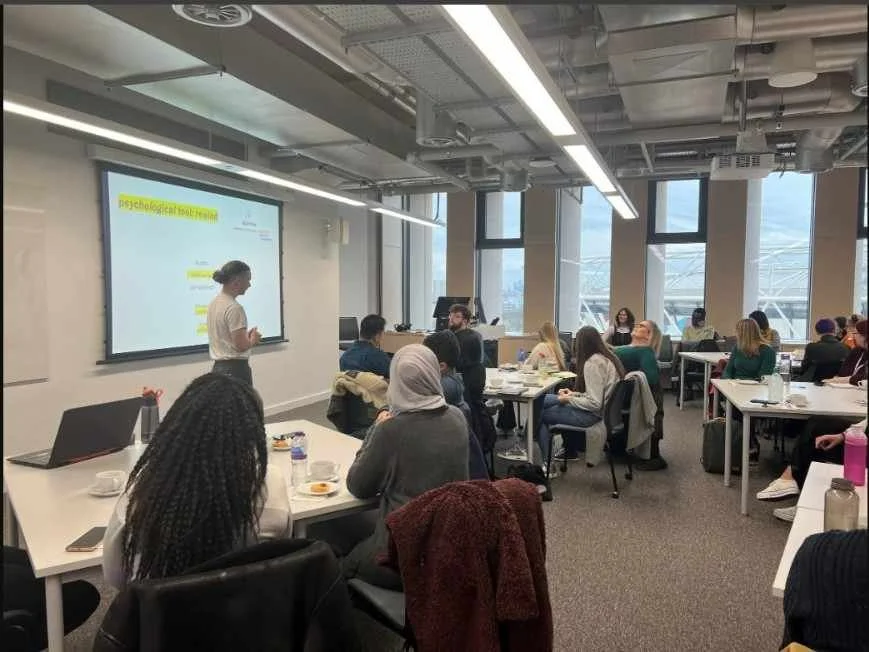
This is an illustrative account of a typical participant experience, not a specific individual.
An immersive workshop is a live, scenario-driven session in which you practise real behaviours rather than watch slides. Trained professional actors play believable characters who respond to what you actually say and do, and a facilitator runs a structured debrief afterwards. It puts you inside a realistic situation so the learning is felt and remembered, not just understood.
I walked in expecting slides
I had been to plenty of training before, so I knew the shape of the day. A room with a projector, a deck with a hundred slides, someone reading the bullet points aloud while we half-listened and checked our inboxes under the table. I sat down near the back, the safe seat, and waited for the laptop to fire up.
It never did. There was no screen at the front, only a loose circle of chairs and a facilitator who asked us, before anything else, to describe a conversation at work we had been quietly avoiding. Not in theory. A real one. The room went honest very quickly, and I realised this was going to be a different kind of morning.
Then a stranger walked in playing my colleague
About twenty minutes in, the door opened and someone I had never met sat down opposite me. She introduced herself in character as a team member who was underperforming and knew it, and who was braced for the conversation I had just admitted I was dreading. She was a professional actor. Within seconds that stopped mattering. She was defensive, then a little wounded, then sharp, and she responded to every word I chose. There was no script for me to hide behind and no pause button to reach for.
I fumbled the opening. I softened the message so much that she genuinely did not understand there was a problem, and I watched her relax in a way that told me I had failed before I had begun. My heart was actually going. This is the part nobody warns you about: it is not a performance you observe, it is a situation you are inside, and your body treats it as real because, in every way that counts, it is.
The discomfort was the point
I will be honest, there was a stretch where I wanted to be anywhere else. Practising a hard conversation in front of peers, getting it visibly wrong, feeling the warmth rise in my face. That is well outside the comfort zone, and the facilitators do not pretend otherwise. What they do is make the room safe enough that getting it wrong is the work, not the embarrassment. Nobody scored me. Nobody filmed me to play back as a gotcha. The actor stayed in character only as long as it was useful, then stepped out and simply told me how my words had landed from the other chair.
That feedback was the thing I could not have got from a slide. She told me the exact moment she had stopped believing I meant what I was saying. A colleague watching named a habit I did not know I had, the way I ask a real question and then answer it myself before anyone can reply. You only find that out by doing it live, in front of someone who will tell you the truth.
We ran it again, and it changed
The power of the format is the second attempt. We debriefed as a group, the facilitator drew out what had worked and what had not, and then I sat back down and had the same conversation again. This time I led with the message instead of burying it. I left silences instead of filling them. The actor pushed back just as hard, but the exchange went somewhere real, and when it ended she told me she had felt the difference. So had I. That gap between the two runs, maybe forty minutes apart, was bigger than anything I had taken from a year of e-learning modules.
This is what people mean by experiential learning, and it is grounded in solid interactive training practice rather than novelty for its own sake. You try, you get believable consequences, you reflect, you try again. The memory sticks because it is attached to a feeling, not a bullet point.
Why it works, in plain terms
Some things cannot be taught, they have to be felt. I had read the theory of difficult conversations more than once and could have passed a quiz on it. None of that survived contact with a person who reacted like a person. What survived was the muscle memory of doing it, getting it wrong, and doing it better, which is exactly why role-play training with skilled actors outlasts the passive alternatives. Sidestream builds these sessions on organisational psychology and behaviour-change work from UCL, Cambridge and Bocconi. The principle is simple: we remember what we do under realistic pressure far better than what we are merely told. Sitting in that chair, I did not need a statistic to believe it. I could feel it.
The actors are not there for entertainment. They are a precise instrument. A good one can dial a character from cooperative to hostile in a heartbeat, hold a specific dynamic so the whole group can study it, and give feedback from inside the scene that no observer could offer. That craft, paired with a facilitator who knows when to freeze the action and when to let it run, is what separates a real immersive workshop from two managers reading lines at each other.
What I took back to my desk
The next week I had the conversation I had been avoiding for months, the actual one. It was not perfect. But I led with the message, I held the silence, and I caught myself before I answered my own question. I had practised this exact moment with my whole nervous system, not just my notes, and that is the difference. If you want the wider picture of how these sessions are designed and scoped, the team covers it across their immersive workshop guide and their work on larger formats.
I went in braced for another forgettable training day. I came out having genuinely changed how I handle one of the hardest parts of my job. That is the honest account, comfort zone and all.