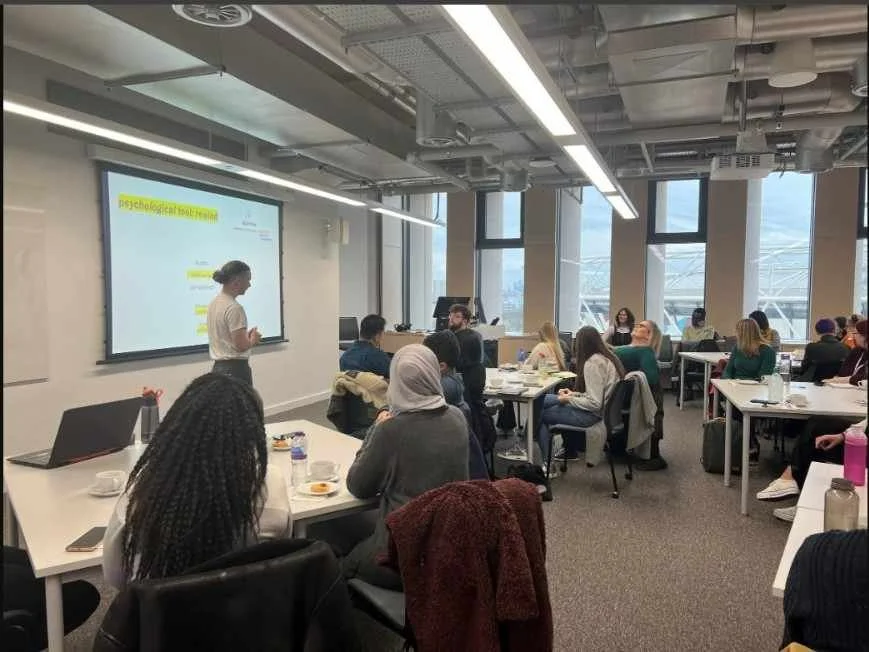
Sidestream prepares senior leaders for development centres and assessment centres through realistic, professionally-acted mock exercises, executive coaching, online assessment and personalised feedback, all mapped to the relevant competency framework. We foreground simulation and role-play with professional actors, because a centre judges observable behaviour under pressure, not what a candidate knows. You rehearse the actual exercises, a difficult one-to-one, a prioritisation task, a stakeholder challenge, then receive coaching feedback against the framework, then rehearse again. Progress is measured at Kirkpatrick Level 3, the level that assesses changed behaviour in a real situation rather than reported confidence. The result is a candidate who performs the behaviour the assessors are looking for, calmly and repeatably, on the day.
A development centre or an assessment centre is one of the highest-stakes days in a senior leader's career. A panel of trained assessors watches you across a sequence of exercises and scores what they observe against a competency framework. The decision that follows can shape a promotion, a place on a leadership programme, a senior command selection, or a personal development plan the organisation takes seriously. And yet most candidates prepare the way they would for an exam: reading about the competencies, rehearsing answers in their head. That is preparation for a test of knowledge. A centre is not a test of knowledge. It is an observation of behaviour.
This is the gap Sidestream is built to close. We are the London behaviour change consultancy whose method is rehearsal of real behaviour under realistic pressure, with professional actors, executive coaching and measurement at the level of observed behaviour rather than self-report. That is exactly the capability a serious candidate, or an organisation preparing a cohort, needs ahead of a centre. This page is the working reference for HR and talent leads, learning and development teams, public-sector and policing candidates, and individual senior leaders scoping preparation.
What a Development Centre and an Assessment Centre Actually Measure
Both formats use the same core machinery: a set of exercises, a panel of trained assessors, and a competency framework against which behaviour is scored. A candidate moves through several exercises, each surfacing a different cluster of competencies, with at least two assessors observing each one so scoring is calibrated rather than dependent on a single impression. That use of multiple exercises and multiple observers is what gives the method its reliability, and what makes it so different from an interview. You cannot talk your way through a centre. You have to demonstrate the behaviour, repeatedly, across formats.
The two formats share that machinery but differ in purpose. An assessment centre is generally used to make a decision: who to select, promote or appoint. A development centre is generally used to inform growth, feeding a personal development plan rather than a pass-or-fail gate. The exercises can look almost identical, so the same rehearsal discipline serves both. We set out that distinction in full in our companion guides on development centre vs assessment centre and what a development centre is. For preparation, the practical point is simple: in both cases, what is scored is observable behaviour against a framework, and behaviour is rehearsable.
Why Behaviour, Not Knowledge, Is What Gets Scored
Some things cannot be taught, they have to be felt, and performing well at a centre is one of them. You can read every guide to the competency framework and still freeze in the role-play, because reading describes the behaviour while the exercise demands you produce it, in real time, with an actor pushing back and an assessor writing down what you do. The behaviours a centre scores are interpersonal and pressured by design: holding a difficult conversation without losing composure, challenging a flawed proposal from a senior colleague, prioritising under time pressure, listening genuinely to a direct report in distress. These are not knowledge to be recalled. They are skills to be performed, and the briefing pack cannot reach them.
There is a second, subtler reason rehearsal matters, and it is about self-perception. The Dunning-Kruger effect describes how people who are unpractised at a skill often rate their own ability as high, precisely because they lack the experience to see the gap. A senior leader who has never been observed in a structured role-play may be quietly confident, and be genuinely surprised by the feedback. Sidestream's own academic behaviour-change work, building on research from UCL, Cambridge and Bocconi, was designed around exactly this problem: it replaced self-reported confidence with behavioural measurement, and found that immersive role-play was roughly 20% more effective than passive modalities such as slide-shows and video at teaching communication skills. Confidence is not competence, and the only way to close the gap is to be observed, given honest feedback, and given the chance to rehearse the behaviour again.
How Sidestream Prepares Candidates
Our preparation has four components, used in combination and tailored to the centre the candidate is facing. The sequence is deliberate: assess, rehearse, feedback, rehearse again.
Realistic, professionally-acted mock exercises
This is the heart of the method and our most distinctive capability. Sidestream works with a professional-actor ensemble, the same craft that powers our award-winning immersive productions, to play the colleague, direct report, stakeholder or panel member in a mock exercise. A trained actor holds a character consistently across rehearsal cycles, raises the emotional temperature when the scenario calls for it, and responds to what the candidate actually does rather than following a script on rails. That realism is what makes the rehearsal transfer to the real day. A role-play with a friendly colleague reading lines teaches little; one with a professional actor playing a direct report who will not be easily placated teaches a great deal. Our wider role-play training uses the same ensemble and discipline.
Executive coaching
Each candidate works with an executive coach who frames the preparation, observes the exercises, and conducts the feedback conversation. The coach does not hand the candidate a set of answers, because there are no answers to a centre. Instead the coach helps the candidate see the behavioural evidence they generated, understand how an assessor would classify it against the framework, and identify the specific, observable adjustments that will raise their performance. For senior leaders this is also where fragile confidence is replaced with the earned confidence of someone who has rehearsed the moment and seen it go well. It sits within Sidestream's broader executive training capability.
Online assessment
Many centres now include an online element: ability and aptitude testing, a situational judgement test, or a personality questionnaire used to structure the day. Sidestream's preparation includes online assessment practice so the format holds no surprises and the candidate can focus their energy on the exercises that genuinely discriminate. Practising the online stage also gives the coach an early read on the candidate's profile, which shapes where the rehearsal effort is concentrated.
Personalised feedback against the framework
After every exercise the candidate receives personalised feedback mapped to the specific competency framework the real centre uses. Not generic advice, but evidence-based observation: here is what you did, here is the indicator it maps to, here is what a stronger demonstration looks like, now rehearse it again. This is the loop that converts insight into behaviour. The candidate does not simply learn what to do differently, they do it differently, under pressure, until the new behaviour is reliable.
The Exercise Types We Rehearse
A centre typically combines several exercise types, each surfacing different competencies. Sidestream rehearses the full range, with the actor-led formats given the most weight because they are where most candidates lose marks.
- One-to-one role-play. A coaching conversation, a performance discussion, a conflict to resolve, a piece of difficult news to deliver. A professional actor plays the other person. This is the single most revealing exercise in most centres and the one rehearsal improves most.
- Group exercise. A facilitated discussion or a collaborative problem with several participants, where assessors watch how you contribute, influence and make space for others. We rehearse the behavioural balance between driving and including.
- In-tray and analysis exercises. A prioritisation and decision task under time pressure, often written, that surfaces judgement, organisation and reasoning. We rehearse the discipline of explaining the why, not just producing the what.
- Presentation exercise. A prepared or short-notice presentation followed by questions, assessing structure, clarity and composure under challenge.
- Competency-based interview. A structured interview probing past behaviour against the framework. We rehearse evidence-led answers that give assessors the behavioural detail they need to score.
Mapping Preparation to the Competency Framework
Every centre scores against a defined framework, and effective preparation rehearses against that exact framework rather than a generic one. Public-sector and policing centres commonly assess against a published competency and values framework; corporate centres use their own leadership model. Whichever it is, Sidestream maps each mock exercise, coaching conversation and feedback report to the specific indicators the candidate's real assessors will use, so that nothing on the day is unfamiliar. For policing candidates in particular, we provide focused preparation in our guide to College of Policing ELP preparation, and our wider work with forces is set out in our police leadership training reference.
How We Measure Progress: Kirkpatrick Level 3
Sidestream measures preparation the way it measures all of its behaviour-change work, against Donald Kirkpatrick's four levels of training evaluation. Most preparation, where it is measured at all, sits at Level 1: did the candidate feel more confident? That is the least useful level, because confidence can rise while competence does not. Sidestream targets Level 3: changed behaviour in a realistic situation. Across the rehearsal cycle we look for observable improvement in how the candidate handles the actor, structures the analysis, challenges the proposal and includes the group, the same behaviours an assessor will score. We explain the full model in our guide to the Kirkpatrick model. Measuring at Level 3 is what separates genuine preparation from a reassuring chat.
Who Development Centre Preparation Is For
The preparation serves both individuals and organisations, and the design flexes to either. An individual senior leader facing a promotion board or a senior selection centre benefits from focused one-to-one preparation, concentrated on the exercise types and competencies most relevant to their specific centre. An organisation preparing a cohort through a development centre benefits from shared rehearsal workshops combined with individual coaching, where the rehearsal itself builds the behaviours the centre is designed to assess, so the cohort emerges more capable, not merely better prepared. Public-sector and policing candidates, assessed against published frameworks with high stakes attached, benefit particularly from rehearsal mapped precisely to the framework in use, delivered by a provider that understands the register of the sector.
How to Start
The first step is a short working conversation. Bring the detail of the centre you or your people are facing: the exercise types, the competency framework, the timescale, and whether this is a selection decision or a development one. We will tell you honestly what preparation will and will not change, and design a rehearsal sequence around the exercises that matter most. The earlier the conversation, the more rehearsal cycles fit before the day.
Book a free 30-min consultation. Or read more on the difference between development and assessment centres, our six-step approach and our case studies.
Frequently Asked Questions
How far in advance should preparation start?
As early as the centre date is known. The method works through repeated rehearsal cycles, observe behaviour, give framework-mapped feedback, rehearse again, and more cycles produce more behavioural change. A few focused sessions spread across the weeks before the day are far more effective than a single intensive session the day before, because behaviour embeds through spaced rehearsal, not through cramming.
Can you prepare a candidate for a framework you have not seen before?
Yes. We map every exercise and feedback report to the specific competency and values framework the real centre uses, whoever publishes it. If the candidate or organisation can share the framework, the rehearsal is built directly against its indicators. Where the framework is confidential, we work from its published structure and the candidate's briefing materials to mirror it as closely as possible.
Do you use real professional actors, or just facilitators reading a script?
Professional actors. The same ensemble that powers our award-winning immersive productions plays the colleague, direct report or stakeholder in mock exercises. A trained actor holds a character consistently, responds to what the candidate actually does, and applies realistic pressure. That realism is precisely what makes the rehearsal transfer to the real centre, where the other person will not be reading lines either.
Is this only for senior leaders, or for any candidate?
The method suits any candidate facing a structured centre, but Sidestream concentrates on senior leadership populations, where the stakes are highest and the behaviours most demanding. We prepare individuals facing promotion boards and senior selection, cohorts going through organisational development centres, and public-sector and policing candidates assessed against published frameworks. The preparation flexes to the seniority and the specific exercise mix in each case.
Development Centre & Assessment Centre Preparation: The Takeaways
A development centre or assessment centre scores observable behaviour against a competency framework, not what a candidate knows, so effective preparation has to be rehearsal of real behaviour under realistic pressure. Sidestream prepares senior leaders through professionally-acted mock exercises, executive coaching, online assessment and personalised feedback, every element mapped to the framework in use. Progress is measured at Kirkpatrick Level 3, the level that assesses changed behaviour rather than reported confidence.
- Behaviour is rehearsable; reading about the competencies is not the same as performing them under pressure with a professional actor.
- The four components are actor-led mock exercises, executive coaching, online assessment practice and framework-mapped feedback, used in a rehearse-feedback-rehearse loop.
- Preparation serves individual senior leaders, organisational cohorts and public-sector and policing candidates, and is measured at Kirkpatrick Level 3 rather than by reported confidence.